
JokaRoom Withdrawals: Payout Process, KYC and What to Verify
 Available in AU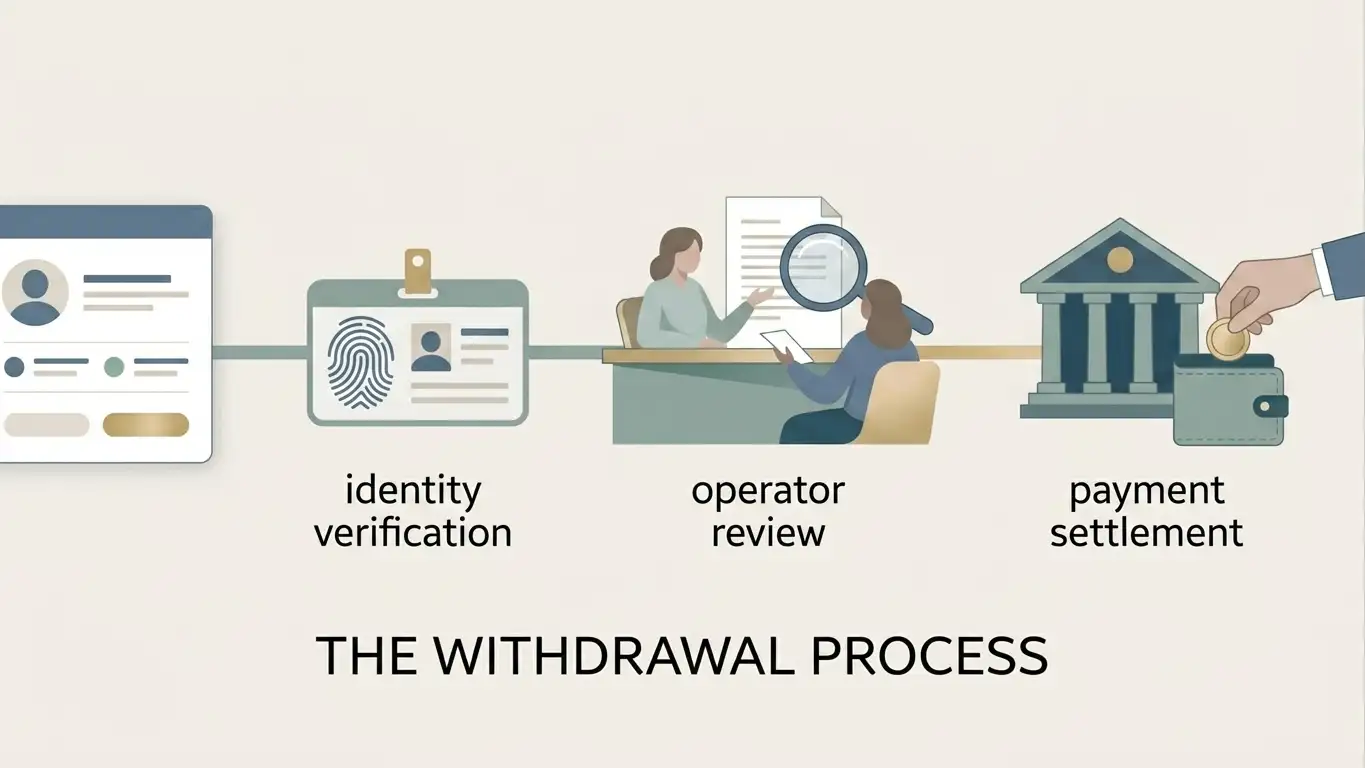
JokaRoom withdrawals involve an identity-verification checkpoint, and current terms say a withdrawal should normally go back to the original funding source or another approved method after KYC and anti-fraud checks. That process is more useful to understand than a headline promise about speed. Current JokaRoom-related sources disagree sharply about exact payout times, limits and fees, so this guide does not turn those conflicting numbers into a single promise. For an Australian reader, there is another important distinction: ACMA listed JokaRoom for ISP blocking in February 2025. A cashier process described by a site does not amount to Australian regulatory approval.
- What is clear about the withdrawal process?
- A four-stage cashout model
- Why exact limits and fees are omitted
- Method matching: what to check before requesting
- How to diagnose a pending withdrawal
- Verification and privacy during cashout
- Australian regulatory context changes the risk assessment
- Practical withdrawal checklist
- What to verify before requesting a JokaRoom withdrawal
What is clear about the withdrawal process?
The most consistent point across current JokaRoom material is that identity verification is part of the withdrawal or account-verification process. Current terms also describe withdrawals as subject to successful KYC and anti-fraud checks, with the original funding source or another approved method used for cashout. Those are process facts. They do not establish that every Australian-facing account sees the same methods, the same limits or the same processing window.
This distinction matters because a payment route can have several stages. A player submits a withdrawal request. The operator can then review identity, account ownership and transaction information. After operator approval, a bank, card network, e-wallet or blockchain can have its own settlement stage. When a source gives one number without saying which stage it measures, the number can be misleading. The practical question is therefore not simply “how many hours?” but “which stage is still pending?”
For the broader funding picture, see the payments overview. That page separates relatively stable categories – AUD-facing card, e-wallet and cryptocurrency options – from individual rails such as PayID or POLi where current sources conflict.
A four-stage cashout model
1. Withdrawal request
The process starts in the cashier with a request against the available account balance. Before relying on a method shown elsewhere on the web, check what the account itself presents at withdrawal time. Deposit availability and withdrawal availability are not automatically symmetrical. A voucher or card can be useful for funding while a different approved route is required for receiving money.
2. Identity and account checks
JokaRoom-related sources consistently connect verification with cashout. Current public material does not provide a dependable universal document list. If verification is requested, the authenticated account should show which documents or information are needed for that account at that time. That is deliberate: a generic casino checklist should not be passed off as JokaRoom’s current requirement. If verification is requested, follow the instructions displayed for the account and avoid sending extra sensitive material that was not requested.
3. Operator processing
After any required checks are satisfied, the request still has to be approved and released by the operator. This is the stage most commonly blurred with the total time to receive funds. Current sources make incompatible claims, ranging from very short processing windows to several business days. Current pages give incompatible timing claims across different stages of cashout, so no single processing time should be treated as universal for every account or payment method.
4. Payment settlement
Once released, the receiving rail can add another interval. Traditional banking, card processing, e-wallets and crypto networks do not settle in the same way. Weekends, bank handling and network conditions can affect the final arrival without proving that the operator itself is still processing the request. Keep the operator-status timestamp and the receiving-payment timestamp separate when documenting a delay.
Why exact limits and fees are omitted
Search results currently show mutually incompatible maximum-withdrawal figures, weekly caps, minimums and fee claims. Some pages say fees are absent, others warn of bank or network costs, and different JokaRoom-labelled sites publish different limits. Those differences make a single exact public value unreliable. The safest useful statement is narrower: minimum and maximum limits can apply, and the account cashier or current terms should be treated as the place to check the value attached to the user’s available method.
The same approach applies to claims such as “instant payout”. A fast individual experience, an affiliate table or a promotional statement is not a guarantee for another account. This page therefore avoids ranking methods by an unsupported universal speed. It instead gives a method for checking the status of a specific request.
Method matching: what to check before requesting
Current terms describe returning withdrawals to the original funding source where possible, or using another approved payment method. Before depositing, it is worth checking whether the chosen funding method is also eligible for withdrawals. If it is deposit-only, ask what receiving route would be available and what verification would be triggered by changing rails.
- Confirm that the account name and payment-method ownership details are consistent.
- Check whether the cashier distinguishes deposit methods from withdrawal methods.
- Read any method-specific minimum or maximum shown in the live cashier rather than copying a number from an old review.
- Keep transaction references and copies of status messages, but redact balances or personal identifiers before sharing them with third parties.
- Do not cancel and recreate requests repeatedly unless support specifically instructs you to do so.
If the issue is primarily identity verification rather than payment routing, the KYC guide explains the account side without inventing a universal document list.
How to diagnose a pending withdrawal
Start by identifying the last confirmed stage. If the request is still awaiting verification, the useful question is whether the account has an outstanding verification action. If verification is shown as complete but the withdrawal is pending, ask support whether the request is under operator review or has been released. If the operator says it has been released, request a transaction or payment reference that can be used with the receiving provider where appropriate.
Document dates in Australian local time as well as any timestamp shown by the service. A clear timeline is more useful than repeated messages saying a payment is late. Record the request time, any verification request, the time documents or information were supplied, approval or rejection notices, release confirmation and the final receipt. Do not publish identity documents, card images, wallet recovery phrases or other credentials as evidence.
When support gives a new limit, fee or processing figure, save the exact wording. Those values are precisely the details that vary across current sources, so an account-specific answer can be more relevant than an unauthenticated web table.
Verification and privacy during cashout
KYC can be a legitimate part of account and transaction controls, but the need for verification does not mean every document imaginable should be supplied. Use the account’s authenticated channel where available, check what has actually been requested, and redact information only where the operator’s instructions permit it. Never send passwords, one-time codes, crypto seed phrases or full card security codes.
Exact JokaRoom document requirements and turnaround times are not consistent enough to state as fixed rules for every account or payment method. The account verification guide explains how KYC fits into cashout and how to handle a request without treating a generic third-party checklist as official operator policy.
Australian regulatory context changes the risk assessment
ACMA requested ISP blocking of JokaRoom in February 2025 after investigations into services operating in breach of the Interactive Gambling Act. ACMA also states that casino-style interactive gambling services such as online slots, blackjack and roulette cannot legally be provided to customers in Australia. This is a provider-side regulatory issue and should be kept separate from whether a website technically displays a cashier or accepts an account.
For that reason, a functioning withdrawal route should not be read as evidence that JokaRoom is licensed or approved in Australia. The dedicated Australian regulatory position page covers the ACMA record and local-licensing distinction in detail. The JokaRoom review puts that status alongside the games, bonus and payments information.
Practical withdrawal checklist
- Before funding, inspect which methods are available for both deposit and withdrawal.
- Keep account and payment ownership details consistent.
- Expect identity verification to be relevant to cashout and respond through the authenticated account channel.
- Use live cashier values for current limits and fees rather than assuming an old web table applies.
- Separate operator processing from bank, wallet or blockchain settlement when timing a request.
- Save a clean timeline of status changes and transaction references.
- Do not treat a promotional speed claim as a payout guarantee.
- Factor the documented ACMA blocking action into any assessment of Australian-facing risk.
What to verify before requesting a JokaRoom withdrawal
The reliable core is simple: JokaRoom cashout is tied to identity verification, method eligibility matters, and a withdrawal can pass through operator and payment-provider stages. The unreliable part is the tempting precision. Current sources disagree on exact limits, fees and timing, so those values should be checked in the live account rather than presented here as settled facts. For Australian readers, the ACMA blocking record is an additional material consideration that exists independently of whether a payment request can technically be submitted.
The full picture is in the JokaRoom review for Australia.
Funding the account first is covered in JokaRoom payments.
Written by the editors at Jokaroom Online.